08 May 2015

Nostalgia

Sometimes, a seemingly unfortunate occurrence may later on lead to an experience that ends on an entirely different positive note. Losing my Driving Licence, which I had kept in a [now stolen] wallet, gave me a reason compelling enough to re-visit the place where I had spent the foundational years of my life (because my licence was issued by the Regional Transport Office lying in the district under which the aforementioned place falls).

Srinagar Garhwal (henceforth referred to as Srinagar) used to be (when I was a child) a small town located in the Garhwal Commissionary of the hill state Uttarakhand (carved out of Uttar Pradesh state on 9 November 2000) in India. Historically, it used to be the Capital of the Garhwal Kingdom till 1804 AD. This was after the king Ajay Pal shifted his capital from Chamoli (the erstwhile Chandpurgarhi) to this place. At present, this place is the largest city (though its expanse is nowhere when compared to that of the cities in the plains of India) in the Garhwal hills. Srinagar is accessible from Dehradun, the capital of Uttarakhand, by road; the distance is about 150 km. The city has a Municipality and administratively, it is a tehsil under the Pauri Garhwal district. The city is home to Hemwati Nandan Bahuguna (HNB) Garhwal University, Government Medical College (Srikot), [presently] National Institute of Technology (Sumari) and the Sashastra Seema Bal (SSB) Officers' Training Academy. Situated on the left bank of the river Alaknanda (which is the largest tributary—in terms of water content—of the river Ganga), Srinagar is situated at an average elevation of 560 m above mean sea level. Contrary to the popular perception, the situation of Srinagar as a hill city doesn't reward it with an affable climate. It sees extremes of temperatures—hot summers and cold winters.

As I neared the police check-post at Srinagar Garhwal on 5 May 2015 (after a gap of almost 4 years) I realized that everything has changed in Srinagar, yet nothing has changed. The city had to bear the brunt of the 2013 Uttarakhand deluge. The river Alaknanda in all its fury submerged the buildings near the banks under enormous amount of debris. Yet today, except for some visible signs of the destruction in the areas near the banks, most of the city seems to have stood resilient in the face of adversity (even though I have been one among the 'locals' of Srinagar for a long time, this account can be considered to be of a 'local tourist' because I had stayed there for just two nights during my sojourn). However, I certify that despite having stayed there for a very brief period, I enjoyed undisturbed-untroubled sleep during the nights. Despite all the hardships that the people of the hills have to face, most of the the hill folks are innately unassuming (although, of late, materialist influences have started to make their foray in this city—all thanks to the revenue generated by the tourism industry during the 'Char Dham Yatra' and the 'Hemkund Sahib Yatra' as also the influx of the mining mafia in the hills). I felt inner solace when I met my old neighbours as well as an old classmate, almost all of who couldn't recognize me in the first instance and cited the reason that I have changed a lot during the passage of the intervening years.

I would like to take a short detour. Even as many of my fellow Indians were busy expressing solidarity with Salman Khan when he was convicted by a sessions court and awarded a 5-year rigorous imprisonment for drunk-driving and trampling pavement-dwellers, I felt much better off by switching-off the television (which I anyway seldom watch) and then enjoying the beauty of the Garhwal hills. Perhaps Mr Khan realized what it is being human [as the accusations against him go] after having hunted chinkaras and black-bucks in 1998 and trampling humans in 2002. As for Mr Abhijeet Bhattacharya, even though you have apologized in public (and it's good that you have done so), let me re-iterate that your tweets were simply unacceptable. To hell with what you did when you had no work, pavement-dwellers are not dogs; you may have intentioned to support a fellow Bollywood personality who runs an NGO by the name "Being Human" but 'being human' includes conferring a compassionate treatment even on animals (and not trampling them under the wheels of your vehicle).

I have uploaded some photographs which I had clicked during my sojourn at Srinagar Garhwal. Some people opine that a picture is worth a thousand words. I hope that the following pictures are able to present glimpses of what I would like to refer to as my 'personal paradise'. I say—"Kuchh din to guzaaro mere Srinagar Garhwal mein" (please spend some days in my Srinagar Garhwal).

Aithana ('ऐठाणा') Village
'Aithana' ('ऐठाणा') village


Aithana ('ऐठाणा') Village
'Aithana' ('ऐठाणा') village


Aithana ('ऐठाणा') Village
'Aithana' ('ऐठाणा') village


Trek Route from 'Aithana' ('ऐठाणा') village to Ashthavakra ('अष्ठावक्र') temple
Trek Route from 'Aithana' ('ऐठाणा') village to Ashthavakra ('अष्ठावक्र') temple; trekking along this path in the morning brought back memories of school days when I used to go for this trek alongwith some of my classmates


Pine trees or 'Pinus roxburghii' ('चीड़')
Pine trees or Pinus roxburghii ('चीड़'); as per one story, these were introduced to Uttarakhand hills by the British who wanted to exploit them for their commercial value; due to the high resin content in their wood, they are used as firewood and their 'needles' almost form a near-ubiquitous carpet on the hills because of which the hills become highly prone to forest fires (दावानल)

'Needles' of Pine trees
Natural Carpet formed by the 'needles' of Pine trees
Female Cone of Pine tree
Nuisance of Human Intervention
Alas! Excessive human intervention is turning out to be bad for the hills. Is this what 'Being Human' is?
A part of Srinagar Garhwal
A part of Srinagar Garhwal (photograph captured from an elevated spot on a hill)
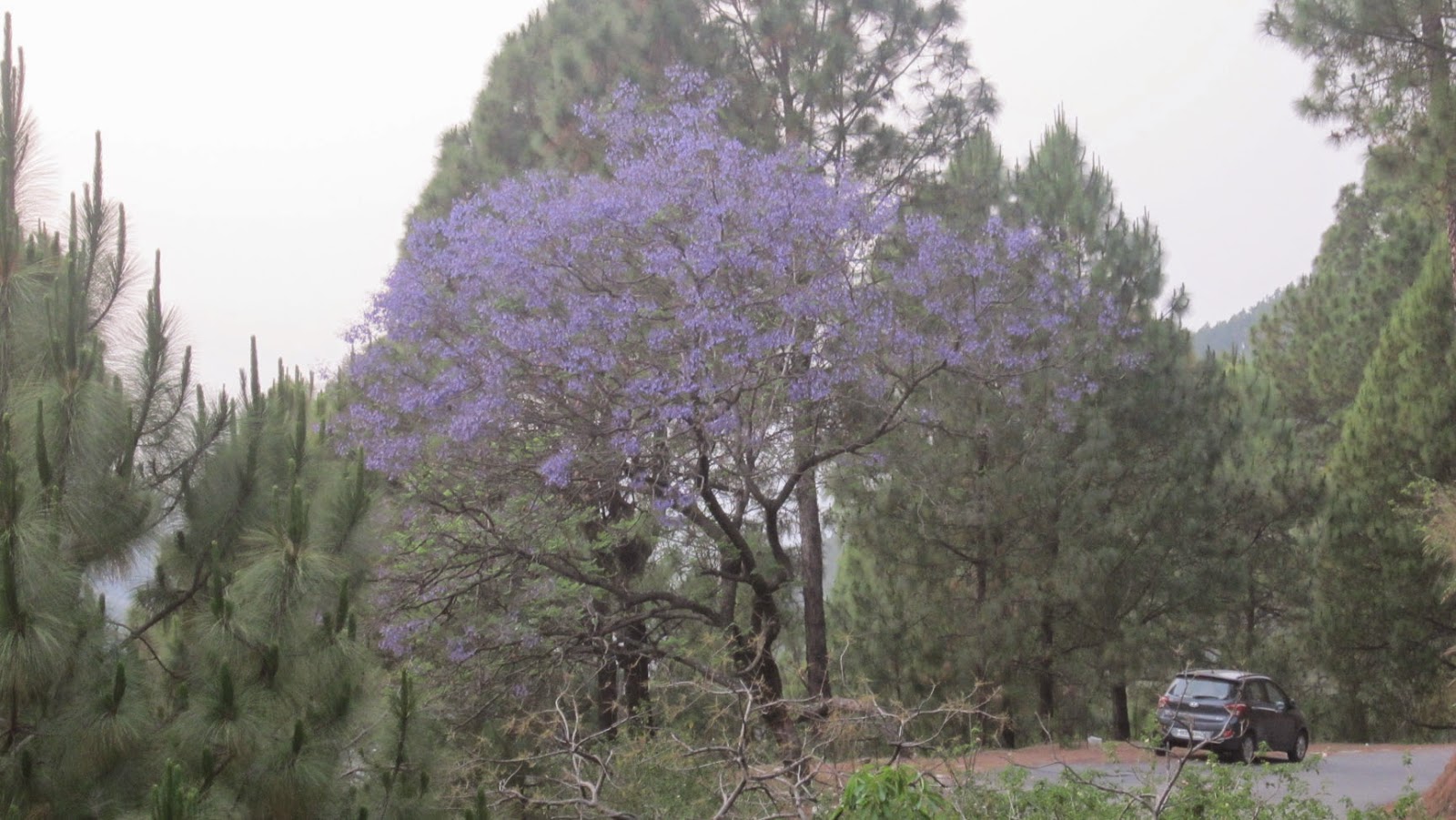
Blue Jacaranda or 'Jacaranda mimosifolia'
Blue Jacaranda or Jacaranda mimosifolia (the violet-flowered tree)

28 April 2015

We Love Cricket!

We love cricket, don't we? After all, isn't that what gives India the feeling of being a nation? Despite having a myriad of religions, Indians have a common religion—cricket. Cricket is so much in our blood that the Government of India had practised even "cricket diplomacy" to improve Indo- Pak relations. And why shouldn't we love cricket? The "gentlemen's game" is indeed one of the precious legacies left to us by the colonial rulers.

We love cricket. Cricket is so important that we cannot keep ourselves from sharing even split-second occurrences of what goes on and outside that sacred 22-yard distance and of what goes on in the lives of cricketers on and off the field. After we lose 'very important' cricket matches, some of us vent our ire on certain cricketers and their personal lives, and some others express our solidarity with them in their 'moments of crisis'. We get emotional and enthusiastic, we scream on the top of our voices, we give expert advice to cricketers on how to play and how not to play—after all, we can't afford to show laxity given that we are dealing with the pan-Indian religion. We "bleed blue" and we almost overlook those who bleed to death. On 26 March 2015, social media was replete with pictures, videos and messages about the Indian cricket team because we had lost a world cup semi-final match to Australia. And this was a very important event, wasn't it? The electronic media chose to highlight this, given the fact that electronic media houses can't afford to overlook it. And why not? Overlooking it would certainly be inimical to their business interests. The same day, the news of a Dornier-228 of the Navy crashing off the Coast of Goa (even when it was an event that happened on 24 March 2015) could scarcely make its presence felt in the electronic media; the print media seemed to be much more concerned than its electronic counterpart about the Indian Navy personnel involved in the crash. There were very rare instances of people forwarding this news through Instant Messaging applications or through social media websites. Two young officers in their 20s—Lieutenant Kiran Shekhawat and Sub-Lieutenant Abhinav Nagori—lost their lives in watery graves. But should we have bothered about it? They bled to death in the course of their job, while the Indian cricket team had gone to perform a 'national duty'.

We love cricket. We do not use social media, not even in the form of one-liners, to spread awareness about the death of the cragsman Malli Mastan Babu even when he used to unfurl the Indian flag on the summits that he scaled. His being an alumnus of some of the most prestigious educational institutions of the country even when he had been from an economically-underprivileged background isn't a qualification good enough to make a social media presence felt posthumously; understandable it is, because he wasn't connected with cricket.

We love cricket. We don't mind expelling some university students if they felt like supporting the Pakistani cricket team. After all, such an act would be an insult to the integrity of India, wouldn't it? We deify cricketers. We post photoshopped images on the social media—images that show Maria Sharapova genuflecting in front of Sachin Tendulkar because she had earlier expressed ignorance about the "God of Cricket". Why shouldn't we? Ignorance about the God of Cricket is tantamount to ignorance about the God of the pan-Indian religion.

We love cricket. It is apt that when the Government of India decides to bestow the Bharat Ratna—the highest civilian honour—upon a sportsperson, it should inadvertently be on a cricketer.

In Shakespeare's Julius Caesar, Marcus Antonius had repeatedly used the phrase "honourable men" to convey something to the "friends, Romans, countrymen". I hope that my erudite readers will be quick to establish a relation between my resort to the sentence "We love cricket" and a usage of the aforementioned phrase in Julius Caesar.

15 April 2015

LETTER to SADNESS (upon HER DEATH)

RIP SADNESS

Dear SADNESS,

I came to know about your painful death a day ago. It is a different thing, though, that I would not have allowed you to enter my door. You had tried your level best to demolish my sense of self and engulf me in your arms. You did this by trying to trace the footsteps of your father, FAILURE, who entered my home as a guest just two days back.

I believe it is my duty to inform you posthumously that you had lost your way when you tried to enter my door. You fell into the moat created by my strong conviction and by the moral support my well-wishers have rendered to me. You were unaware that your father has been a very dear friend of mine; I learn more from him than from anyone else.

I consider it my duty to inform you posthumously that I got to hear some of the most encouraging statements from my well-wishers after your father entered my home as a guest. They have told me that irrespective of the position I hold in life, irrespective of my professional standing, they will always have faith in me. Even if I am not able to maintain regular communication links with them owing to the exigencies of the pursuit of my current endeavour, they believe in what I do and stand by me.

I know it is my duty to inform you posthumously that I have bettered as a human being, as the years passed by, while pursuing my goal of self-actualization. Your father hasn't killed me; he has made me stronger. He has made my value known to a large number of people in life; many of the seemingly successful people cannot claim to have amassed such an enormous human capital during all this while. I have truly witnessed my Idea of India, given that people from all corners of India (and some even residing overseas), people used to working in diverse work environments, and people belonging to diverse social and economic backgrounds, have expressed solidarity with me. I wish to tell you—your father has felt proud that he visited my home. I also know that I can rightfully claim to have achieved a level of personal development many others can only dream to achieve. Even though my efforts may not seem to have achieved the desired outcome yet, they have prepared an intense groundwork of roots (in just the same way as the roots of bamboo) for me to stand upon; they have strengthened my foundation.

While I wish (keeping in my mind the norms of common courteous conduct) that your soul may rest in peace, I unabashedly tell you that your presence will not be tolerated by me. Your soul may not resuscitate itself because my well-wishers believe in me and I believe in myself. My suggestion to you is to not disguise yourself and to not re-enter my home upon your re-birth, as the shock of another defeat may not be bearable for you.

Yours never,
Vitthal

25 March 2015

Where is my "Ocean of Opportunities"?

Dear Primus inter pares,

I write to you to draw your attention towards my plight—the plight of an anonymous soldier. If you want to know my identity, I am anyone among those numerous guardians of the Indian territorial boundaries, who are entrusted with 'securing the Indian borders'.

Whenever I don the drab, I am hailed by the Army media campaigns through the words 'jeena to aise jeena' (life should be lived like this); when I put on the pristine blues, the Air Force declares that I 'touch the sky with glory'; when I wear the whites, the Navy avers that 'I have an ocean of opportunities'. What happens when an unfortunate accident cuts short my life and my aspirations? The political class clamours to issue brief and eloquent statements praising my bravery for having made the 'supreme sacrifice'. My national-flag-draped coffin earns gun salutes, medals and scrolls are conferred upon me posthumously and a road or a school or a petrol pump is named after me. I understand that insurance money and other such consolatory mechanisms cannot compensate for the loss of a human life, and yet, it is expedient in the name of economic efficiency to put a monetary value on a soldier's life. But what then? What after the flames on my pyre die down in the memories of the people? Life goes on, and everybody moves on. I wouldn't have wanted it to come to a standstill, but shouldn't there be an effort by the political class to reduce such tragedies?

When I applied to join the defence forces, I understood that there was a risk involved. Yet, my desire to get a respectable career got the better of my fears. While I was alive, I had spent precious moments with my course-mates in the services. We had been through thick-and-thin, and I witnessed a level of camaraderie that I might not have expected, had I been a civilian. After I've passed away, they do not have a recourse if they want to re-live those moments. In the call of duty, I took bullets to my chest, I flew in coffins in the skies, I met watery graves. Yet, the political dispensation seemed to act at a snail's pace in the areas in which it was required to act. When I say this, I refer to the delayed defence acquisitions and technology transfers, ageing fleet of ships and reducing squadrons. I ask of you: who is responsible for stifling me? Should I take to task the bureaucratic red-tape for throttling my trachea? Or should I ascribe this to a paralysis of political will? When the 5-year term of a Lok Sabha M.P. gets over, all that (s)he loses is a parliamentary seat and the parliamentary privileges attached to it. The taxpayer loses a lot of money which had been incurred on procuring defence equipment and on the training imparted to me for protecting him. The nation-state loses, perhaps, a human resource. I LOSE MY LIFE while guarding the Westphalian borders.

The Air Force Act, 1950, the Army Act, 1950, and the Navy Act, 1957, lay down that my freedom of speech and expression through publication in any form in any medium of communication is restricted. Thus, I cannot speak out my plight to the people without express authorization from the Central Government or from any of its representatives. It surely must be imperative in the interest of national security to do so, but what about the political representatives who are supposed to act on my behalf in front of the citizens whom I am required to protect? And am not I a citizen of my own nation-state, whom the State is supposed to look after?

I do not demand an explanation or a verbal response from you: I've had many in the past. What I need from you and your ministers is concerted action that would prevent my future avatars from getting routed due to systemic lapses. This would be the biggest tribute that I can ask for.

Your sincere guardian,
Anonymous Soldier

Being a "Yes Man" versus Being [Hu]man[e]

  Being a "Yes Man" versus Being [Hu]man[e] 27 June marks the Death Anniversary of Field Marshal (FM) Sam Hormusji Framji Jamshed...