31 July 2020

Semi-Rational Criticism and a Chalice of Malice

We seem to have come way ahead of the historical definitions pertaining to topics of polity. In fact, history in itself is replete with instances of change—evolution is the term that sounds more suitable. The classic definition about the edifice of democracy resting on three pillars of legislature, executive and judiciary seems to have undergone a partial metamorphosis into five pillars now—the newer ones being ‘media’ (the fourth pillar) and ‘civil society’ (the fifth pillar). In a Westphalian model of democracy, wherein the real executive (and not the nominal one) is formed out of a subset of legislature, the importance of the two newer pillars, provided they are fair & impartial, seems all the more pertinent. Thus, in this new era having five pillars of manifested power of the dēmos, popular control over the executive might be exercised in a much better way. Hark! Did I hear someone yelling ‘vested interests’? Let us examine a case in point…


A few days back, the life of a promising young actor from the Hindustani film industry (it seems to be a more encompassing term to me than Bollywood) was cut short by Fate. It was a matter of concern for me and my college-peers in this regard, because the actor had been a college senior to me. And even though I had not even personally seen the individual during our college days, let alone having interacted with him, I could feel a sense of loss in that someone from an alma mater had met an ill fate. A WhatsApp Group comprising of college friends had posts containing multimedia from the past being shared as a token of remembrance for the departed. Reactions such as this one seemed quite normal to me, given that all had a sense of belongingness deep within.


However, a few days later I started observing the peculiar behaviour of ‘civil society’ which was using its tool of instantaneously attention-grabbing social media platforms. It was exacerbated more so by the fact that the ongoing COVID-19 crisis has forced people to prefer staying indoors, and hence all expressions/voices containing condiments of annoyance-belligerence-concomitance-defiance were finding their way in the “global common” of social media. One particular public figure vocally raised some parallel issue, resultantly created a so-called online storm, and then a lot of others joined in in chorus. What seemed ridiculous to a far lesser intellectual like me was the way the loss caused by departure of someone was subsequently used as an occasion to communicate/express statements, many of which otherwise seemed logically disconnected, even to the point of callousness towards many other public figures who had chosen to remain silent on the matter. Many, from amongst the online ‘follower’ component in the civil society sans the public figure, were happy to indulge in a debate which was triggered off by the public figure. To a crippled-intellect like me, what seemed like a conclusion was that most of such people who have no stake in a particular issue are still Social Media Warriors. If the Corona Warriors are contributing to the medical well-being of society, well, why shouldn’t Social Media Warriors contribute to the intellectual well-being of the civil society?

Suggesting someone directly to mind one’s own business so as not to talk without facts as bases on matters under investigation, sub judice matters, etc., is perceived as stifling of healthy criticism in a flourishing democracy in which civil society seems to have all rights of taking suo moto cognizance of matters ranging from articulated to adjudicated, investigative to interplanetary.

But my first question is – what about commenting on ‘Semi-rational Criticism’? Readers can be the better judge.

And my second question is – shouldn’t there be an ethical line self-drawn by public figures, who have a greater social responsibility due to their online/offline ‘followers’, to spare the envenoming and prevent any possible Chalice of Malice from spilling?

I don’t know why I’m recalling an idiom here which was taught to us by our Hindi teacher during our school days – ‘Behti Ganga mein haath dhona’!


Façade might have a potential of fomenting ‘fasaad’


Even now, as I see vocal social-media proclamations from the ‘civil society’ about how beautifully the departed actor has acted in his last movie, I personally feel that my college senior had displayed superior acting skills even in other productions before. Right now, the public reaction seems akin more to ‘The Dark Knight effect’, as I would like to call it (for those who are contextually unaware, please read about Heath Ledger from the internet).


I loosely believe in the theory of Karma – 'what goes around, comes around'. What I want to make home as a point is that we as a civil society need to be rational in our criticisms. The idiomatic ‘adh jal gagri’ (loosely translated in English meaning to the idiomatic ‘empty vessel’) adds confusion to an informed discourse. And the chalice of malice needs to be cast away on an ethical consideration. Else, whether the phrases ‘civil society’ and ‘civilized society’ deserve, or not, to continue to be used interchangeably – I shall leave here for the readers to decide.

05 July 2020

The Lockdown - Social, Psychological and Societal aspects and Newspeak

Whereas, novel Corona virus (COVID-19) had been declared to be a disease of pandemic proportions by the World Health Organization (WHO);

And whereas, in the interest of public safety, the Government of India (GoI) had already issued necessary regulations for implementation in the form of guidelines carrying the nomenclature ‘Lockdown’ measures, alongwith dissemination of information about the appropriate penal provisions to keep defaulters at abeyance;

And whereas, subsequent ‘Unlock’ guidelines have already been issued by the respective state governments and local authorities to re-start the pre-lockdown economic activities alongwith the necessary safety precautions;

And whereas, the imagination of a certain section of the creative public has already been captivated, even to the point of frenzy, by the usage of acronyms by various state and non-state actors;

And whereas, certain sections of the media have been seemingly spewing the proverbial venom against variable “aggressors”—with a perceptible aim of securing an increase in TRPs from amongst the frenzied audience base;

And whereas, the COVID-19 crisis seems to have introduced a fear psychosis amongst the less-analytical proportion of the general public, to varied proportions ranging from mild to extreme;

And whereas, a common-sensical approach in dealing with the aforesaid crisis seems to have been a thorough understanding of the do’s and don’ts juxtaposed with a logical observance of the necessary precautions for avoidance of contamination;

Now therefore, in the exercise of creative powers that have been bestowed upon me by Fate, I hereby faithfully, and with a bona fide intent, write this post to analyze the social-psychological-societal aspects of the proverbial lockdown and the Orwellian Newspeak, which has seemingly appealed to the popular imagination with effect from the said period and till this date…


Ever since GoI decided that it was best to contain the spread of COVID-19 through the implementation of social austerity measures by way of closely-monitored regulation, the ‘lockdown’ and ‘unlock’ seem to have become the watchwords amongst the Orwellian Newspeak which is gaining traction in the current era. Some such other Newspeak terms were ‘aatmnirbhar’, which evoked various interpretations from the creative junta in the form of memes and trolls. At the same time, the overall reactional behaviour of the general public could be loosely defined through the usage of the gerund triad “Brooding-Drooling-Trolling” (hereinafter referred to as the acronym BDT)!
“Brooding” – by the vulnerable sections amongst the general public
“Drooling” –  by the unsuspecting sections amongst general public over
  electronic/print/social media content
“Trolling” –   by the Coterie Limited of Twitteratti and others
At this point of time, I consider it best to present a few classic examples so as to allow the readers to opinionate about our societal progress, statistically-speaking, in terms of the educational parameters (please mark my words, the parameters are educational, not literary).


A few days back, I was somewhat surprised, even appalled, at how certain sections amongst the society (there were a few personal experiences, in various forms, as well) had become so reluctant to disallow the ‘ingress’ of the perceived ‘outsiders’ into the residential cocoons of their nuclear families that they did not realize that such a reluctance on their part was bordering on the dividing line between familial safety and callousness. What was all the more surprising was that while we as a society lay a lot of emphasis on the fact that our children get a better education (an umbrella term to, euphemistically, mean education in the so-called “reputed” schools and institutions of higher learning), we might still be facing an inertia when it comes to application of those educational values in the societal domain. As far as my understanding about education goes, BDT alone does not suffice if projected views are not backed by logic/rationale. An enhanced literacy rate does not seemingly help in inculcation of scientific educational values; at best, it might help in the enhancement of educational standards. Furthermore, I was faced with a larger question: is a fear psychosis, whether in mild or strong proportions, such a big factor in deciding our course of action as to completely sideline the fiduciary tenets of relationships against familial safety concerns?

Creative Vents (CV) and Culinary/Calorific Sabbaticals (CS)
[Note: As a micro-elaboration, the word-choice has been made to suit the previously selected acronyms.]


Since the lockdown and the related side-effects began manifesting themselves on the ground, the reeling question which a particular segment amongst the ‘social media society’ seemed to inherently project through their various verbose social media expressions was: “Lockdown mein kya karein”?


It was as if most of the regularly-employed people had so much forgotten to segregate their jobs with the other aspects of their life that they were not able to decide what to do with the ample time that the lockdown seemed to have ‘bestowed’ upon them. At the end of this blog post, I have shared some of the Creative Vents (CV) that have been ingenuously/passionately discovered by some talented individuals who are personally known or related to me.
Also, what this segment amongst the ‘social media society’ had seemingly overlooked was that there are a few other segments out of the employed workforce in our country, e.g., the armed forces, whose personnel have to work in such theatres as Jammu & Kashmir (J&K), Left Wing Extremist (LWE) areas, High-Altitude locations, where there is a state of perpetual virtual lockdown almost throughout the year!
The question of Culinary/Calorific Sabbaticals (CS) versus the memes regarding ‘post-lockdown weight gains’ (which were doing the market rounds) seemed like a dilemmatic situation for a category of creative talents.
Avid travelling enthusiasts like me, who felt stifled by the prevailing pragmatic restrictions, were forced to write a post such as the one which the worthy readers are currently reading or to take to video-editing about past travel history.

Electronic Media Experiences (EME)

While the question gripping the health departments of the states and the policy-makers was how to expand and enhance better facilities for COVID-care (which is another Newspeak expression), a section of the electronic North-East-West-South (to be read as news) media seemed so much passionate about loading word-ammunition against variable “aggressors” that at times I had to duck in front of the television screen to avoid being hit by a volley of word-bullets! The TRP-based cut-throat competition amongst media houses is evident in the form of the anchors’/presenters’ indefatigable spirit to slit the throats of the unfortunate “aggressor” who has been chosen as the subject matter for a particular news Bulletin/Debate/Ticker (the Return of the ‘BDT’). How I wish these anchors/presenters could be dressed in combat clothing and taken to national territorial boundaries where saber-rattling might pay better national dividends at some point of time or the other; as a corollary, soldiers would get to have a day off!

Fitness Condiments (FC)

The lockdown restrictions caused a drop in huge numbers in the posts of a particular spectrum of social media users whose social approval requirements were hitherto somewhat limited to image/video uploads about their outdoor-based or gymnasium-based workouts. Nevertheless, this segment seemingly chose to shift towards uploading image/video content about indoor-based workouts and yoga-meditation sessions. Of course, it goes without saying that some such content was accompanied by motivational quotes, the target audience for which was variable on a case-to-case basis.

Human Relationships (HR)

For those who were almost accustomed to viewing the acronym HR in the workplace-sense, this lockdown might perhaps have been an eye-opener in that a Homo sapien was looked at as more than a Human ‘Resource’. I, for starters, who always knew that there is a greater need to understand the importance of physical meetings as compared to the video calling in vogue, realized that a dearth of something only elevates its price. The unique selling point of this lockdown, for me, was the time it awarded at an individual-level to think beyond the usual business. In the observance of routine work-schedule, we might often develop a tendency to forget a sentiment—that information technology tools are supposed to be the means to human relationships, and not an end in themselves. The sentinels against psychosis are those memories which have been created out of human physical interactions, and not the social media aided ones.

A creative effort by my friend Shrikant Tuli, who has tried to portray through various examples why it may not be a wise thing to resort to religious/communitarian alienation against particular sections of the Indian population

Sketches made by my creative niece Jiya Pandey (a Class IX scholar)

Note: The usage of images in this blog post has been made strictly for representational purposes. The placement of images at particular places does not intend to have any specific connotation other than representation.

(This blog post has been inspired by my personal experiences accrued out of limited interactions with relatives and friends during the nation-wide lockdown/unlock period. They shall not be named here, as prior approval has not been sought/obtained from them for the same, except from Advocate Prateek Pundir with whom a particular telephonic conversation resulted in the commencement of a train of thought within my head.)

21 April 2020

Leadership

“Success spells Hard Work”.
“Dignity Decorum Devotion”.
“Service Before Self”.
“Work is Worship”.
“Dedication, Steadfastness and Truth”.

Institutions often claim to have committed themselves to a cause, which they usually project by way of an adopted motto. Though surely there would be many, I haven’t personally come across an institution which lays claim to “producing” leaders with an output-to-input ratio of 1:1.

Leaders, as the word would suggest, are those individuals from amongst a group of people who have the capability of guiding that group towards achieving a particular cause by setting imitable personal examples intermittently. In all walks of life, and across professional/non-professional fields, leadership can be found in varied dimensions. Truly speaking, no blueprint or prototype could be defined in a textbook manner, adopting which could turn an individual into a leader. Nor can conferment of institutional authority over an individual automatically turn him/her into a leader. Some leadership qualities may be found in an individual in situ (“nature” —so to speak) and yet others can be developed in an individual over the passage of time (through “nurture”).

As we move through the possible reasons for requirement of leaders to the various leadership qualities (which I shall categorize into essentials and desirables), we shall try to examine what it takes to become a leader. In the process, I hope that readers would associate examples from their own professional/non-professional lives to analyze whether many amongst the individuals whom they observe playing leadership roles are worthy of being termed ‘leaders’, or that most of them are merely paying lip service in their roleplay.

Why a Leader?

While not going into the historical instances of origins of leadership, one point-of-view about the requirement of a leader shall be hereby explained. It would have been splendid, had all the individuals who wish to achieve a particular cause, or who are placed at a particular institutional pedestal, possessed a quality of thinking and acting unanimously all the time. Practically, there is always a requirement of a moderating/governing body which carries out the task of rational assessment of each and every step that is proposed to be taken to achieve a particular goal. Such a body, at the helm of its affairs, needs to have a leader who directs logical discourses and finally sanctions a particular course of action on behalf of all the individuals who wish to achieve a particular cause. Additionally, an individual who has been chosen to be the leader, is expected to possess and put to use certain qualities (essentials and desirables) which most other people belonging to that group might be lacking. In institutions which have designated leadership roles, the person holding a leadership role is expected to have (or to have developed) such qualities through education and/or experience. In the following paragraphs, the term “leader” has been contextually used to represent someone who has either been chosen as a leader of a group devoted to a particular cause or someone in whom an institutional authority to play a leadership role has been vested. An underlying assumption has been taken that the followers/subordinates do not have their personal ambitions of usurping the leadership role.

Let us first have a look at the Essential Leadership Qualities which are required in an individual for a leadership position:
1.      Truthfulness: There is a Latin maxim which states Vi Veri Universum Vivus Vici—by the power of truth I, while living, have conquered the universe. The most important aspect of functioning of a group/institution to be understood by a leader is the fiduciary aspect. Truth forms the very foundation of group/institutional relationships. A leader who, through both word and deed, projects the true aspects of any issue in front of his followers/subordinates is bound to have an environment devoid of suspicion. Furthermore, the leader should understand that on a continuous basis, the leader has to build mutual trust among all the individuals present in the group/institution.
Often, individuals might tend to view truth through their own perspective and they may contend that truthfulness can be issue-based. The habit of viewing truths from a particular perspective may be developed through nurture. However, an individual’s instinct about effective communication of a particular truth is something which cannot be taught through nurture, but rather has to be natural.
2.    Determination: A leader’s commitment to achievement of a particular cause is directly proportional to the intrinsic quality of determination which the leader should possess in situ.
3.      Perseverance: There is a very famous story about how King Robert the Bruce was inspired by a spider as to how one should keep on pursuing a goal despite the oddities. Perseverance is the practical manifestation of determination. No benchmark could objectively be defined for this quality; nevertheless, this in situ quality is something whose glimpses are visible in a leader’s day-to-day actions.
4.      Courage: There are many forms in which courage, which could be called an umbrella term, can be exhibited. Courage is required to form an independent opinion and to thereafter stand by it. Courage is also required to persevere ‘when the chips are down’.
One of the finest examples of courage is the ability to render support to the followers/subordinates against the adversaries or the institutionally more powerful. In this regard, Field Marshall SHFJ Manekshaw had famously stated:
“A ‘Yes Man’ is a dangerous man. He is a menace. He will go very far. He can become a minister, a secretary or a Field Marshall but he can never become a leader nor, ever be respected. He will be used by his superiors, disliked by his colleagues and despised by his subordinates. So, discard the ‘Yes Man’”.
5.       Empathy: Simply put, any action before execution should always be put to test by the leader by proverbially putting himself/herself in the followers’/subordinates’ shoes. Empathy is something which cannot be simply taught to someone. It is essentially the part of someone’s nature. The power that a responsible position confers upon a leader should not be used to reign in corruption. A simple self-assessment test for a leader is that the moment when he/she has to assert his/her authority in execution of an action by explicitly verbally stating it is also precisely the very moment when he/she has failed miserably in being a true leader.
6.     Adaptability: Adaptability to the environment is a testimony of the intelligence and emotional quotient of the leader. Change is the law of nature and thus inflexible individuals, when they are assigned leadership roles, are bound to bring a downfall to the group/institution.
7.    Self-Control over Prejudice: To err is human. Human beings are vulnerable to forming prejudicial views based on non-balanced opinions/perspectives. However, the job of a leader is to make sure that self-control wins over prejudiced views while deciding about the fate of his followers/subordinates.

Having gone through the Essentials, the Desirables for a leadership position are as follows:
1.         Logical Thinking: Any decisions which are taken based on logic are bound to stand a greater chance of success. One of the aspects of logical thinking are to take into consideration alternative points of view, and to not merely dismiss/snub counter-views as regressive ones.
Definitiveness should be exercised only after a due logical deliberation over the varied view-points concerning an issue, not before it. Prejudicial rejection of view-points could be a result of ego, which is not beneficial for the group dynamics.
2.        Rhetoric: Rhetoric, one of the three ancient Greek arts of lower division (Grammar and Logic being the other two), is the art of persuasion through spoken or written word. A leader’s soft-skill of non-coercive persuasion is a very effective tool in getting a task executed; it also helps in preservation of respect in the minds of the followers/subordinates towards the leader.
3.  Positivity: Positivity in the leader percolates in a top-down way through the entire group/institution. It is an asset for the mental well-being of components of the group/institution.
4.   Morality: Morality and ethics cannot be simply described in a nutshell. It is, however, instinctive thinking that sets aside a leader from the herd. Walking the walk after having talked the talk is one of the confidence-building measures that emanate from morality. Truthfulness, which has been enlisted as a separate essential quality, is another aspect of morality.

A person aspiring to be a leader should always know that his/her word and deed are almost always in scrutiny under the watchful eyes of his/her followers/subordinates. The simplest and yet most effective maxim that leaders should follow is ‘Look before you leap’. Sometimes, silence is indeed, proverbially speaking, ‘golden’. Leadership, as has been said, can never be based on a rigid prototype; it is rather the by-product of the exercise of a judicious mix of the essential and desirable qualities in an individual.

15 March 2016

FLASHBACK

आशियाने की तलाश में सड़क की राह पकड़ी थी,
आज इतनी दूर निकल आया हूँ कि सड़क ही आशियाने-सी लगती है।

Keep on Walking
On 18th of July 2015, I had embarked on a new journey. After having toiled in the preparation for civil services examination, which did not fetch me the desired results, I joined Campus Law Centre under the Faculty of Law, University of Delhi, to pursue a degree in law—Legum Baccalaureus (LL.B.).

Presently, as I turn back and reminisce, time seems to have, as always, played a bittersweet symphony for me. Getting to meet and know about a lot of new people was one of the perks associated with coming back to the ‘campus life’. I may not say with any sense of conviction how many of them would be desirous of being in touch with me in future, or whether they would cherish the moments, even if fleeting ones, that I had spent with them. Looking from my lenses (I may be at risk of being accused of having a myopic vision), the ‘juice was worth the squeeze’, the moments gained were worth the time invested.

It is very cumbersome, simple though it may seem to be, to ‘define’ what is bliss. I do not claim any extraordinary erudition for myself in this regard. I do, however, recollect a few instances of events, the memories of which I surely will associate with the word ‘bliss’:

  • It isn’t everyday that one may get to spend quality time with an old friend. Impromptu conversion of a previously planned 100-kilometre road trip into a 200-kilometre one is a very small input for the aforementioned output.
Chakrata Road Trip
  • Upon evaluation of the returns, a 3-day Delhi–Jammu–Delhi trip doesn’t at all seem to be hectic or tiresome. After all, it is not everyday that you have a C2H5OH-induced debate over philosophy, followed by a late night drive to a remote lake area, on the way to which you muse over fictitious ghost stories.
Jammu Trip
  • The numerous birthday celebration events (‘events’ = cutting the cake + posing for photographs) in the college used to serve as beautiful reminders of my childhood birthday-celebration parties, in which my family members used to painstakingly prepare and serve delicacies to my friends and other guests.
Birthday Celebration
  • A visit to Delhi Book Fair 2015, the morning exercise sessions on the Lake Park near Brigadier Hoshiyar Singh Marg and the occasional ‘kaju shake’ sessions with friends, visits to Jawaharlal Nehru University campus, a visit to a friend’s Passing-out-Parade ceremony and pipping him on the shoulders, numerous chit-chats and text message exchanges on WhatsApp and Telegram—are all grand memories.
Delhi Book Fair 2015

Jawaharlal Nehru University
WhatsApp Chat Excerpt
WhatsApp Chat ExcerptWhatsApp Chat Excerpt


  • A solitary 90-kilometre/5-hour bicycle road trip and a Dehradun–Mussoorie–Landour 8-kilometre trek with a friend act as minute reminders that the strength in my body hasn’t veined with the passage of a few years. The memories of my mother’s reaction over the phone upon receiving the news of my bicycle trip—that “you’ve gone half-mad”—and of the alarmingly chilli-chutney served alongwith the plate of momos at a joint in Landour are invigorating instances for the mind.

Dehradun–Paonta Sahib–Dehradun Bicycle Trip

Mussoorie–Landour–Lal Tibba Trek
  • Words of encouragement from a childhood friend—“if that mole-rat” (please mark the use of a metaphor for a chap) “could make it to the top of Chandrashila, why can’t we?”—are not heard often, but are to be cherished.
Way to Chandrashila
  • An unforgettable memory is of my mother’s comment when I reached home after a long and arduous Srinagar Garhwal–Chandrabadni–Srinagar Garhwal hill drive followed by a ‘session’ with a childhood friend on New Year’s eve—that I behaved “like a roadside driver who needs to consume to pacify and relax the senses after a long drive”!
  • In certain places of the country, certain miscreants are occupying media space and trying to chart out a political future for themselves by resorting to shenanigans and gimmickry through vague and illogical statements based on dumbfounded concerns. They feel that they ‘need azaadi within the country, and not from it’, even as they simultaneously lead other unsuspecting, but emotionally-belligerent, pawn-like adherents through highly romanticized notions of petition-protest-purge. And all this is done from the comfortable couch of a university campus. But there are other places in the same country where time seems to have come to a still. People are not bothered about sloganeering for unfounded aims; rather, there is a need to ensure survival and fulfilment of basic necessities. The Gonds of Chhattisgarh and the residents of Munsyari (Uttarakhand) seem to be living in their own world of time-dilation. A stay for about 10 days at a Naxalite-infested area in Bijapur district (Chhattisgarh) was an experience of its own kind. Making a feline friend in that location, displaying herpes-induced “Raymond Shirts-styled” real-world advertisements, visiting certain girls’ and boys’ residential schools located in the nearby areas, driving a truck, sharing some lighter moments and playing practical jokes—were some of the many take-aways from that visit. I think [my friend will understand this very well as he reads it] that we surely know ‘how to make enemies and offend people’!
Chhattisgarh Trip

Similarly, a visit to a small pond (Thamrikund) and a late evening bath in a hot-water sulphur spring followed by the unfortunate event of a stolen mobile phone was a cake, the icing on which was put by dirt-biking over dust-and-pebble-strewn sloping road from Munsyari to Madkote and back to Munsyari. In Munsyari, time comes to a halt as people find solace in playing carrom and cards, as also in placing small bets over these games, which do attract a crowd of quite-a-size. All this seems to happen under the supervision of the imperial Panchachuli peaks.
Munsyari Trip
  • The memory of pedal-boating on a lake and of teasing a friend to consume ‘duck-roast’ from among the ducks which we were feeding [corn] and fattening is certainly a harbinger of solace. And…how can I fail to mention here?—the almost-Monsoon-Wedding (or rather, a ‘Western Disturbance Wedding’, to be technically-and-meteorologically correct) of a friend.
Naini Lake (Model Town, Delhi)

'Western Disturbance Wedding'

बयाँ करने को तो बहुत-कुछ है, मगर ये लफ़्ज़ कुछ खफ़ा-से हैं।
हसरत महज़ इतनी है कि वक़्त की रफ़्तार कलम पर भारी न पड़ने पाए!


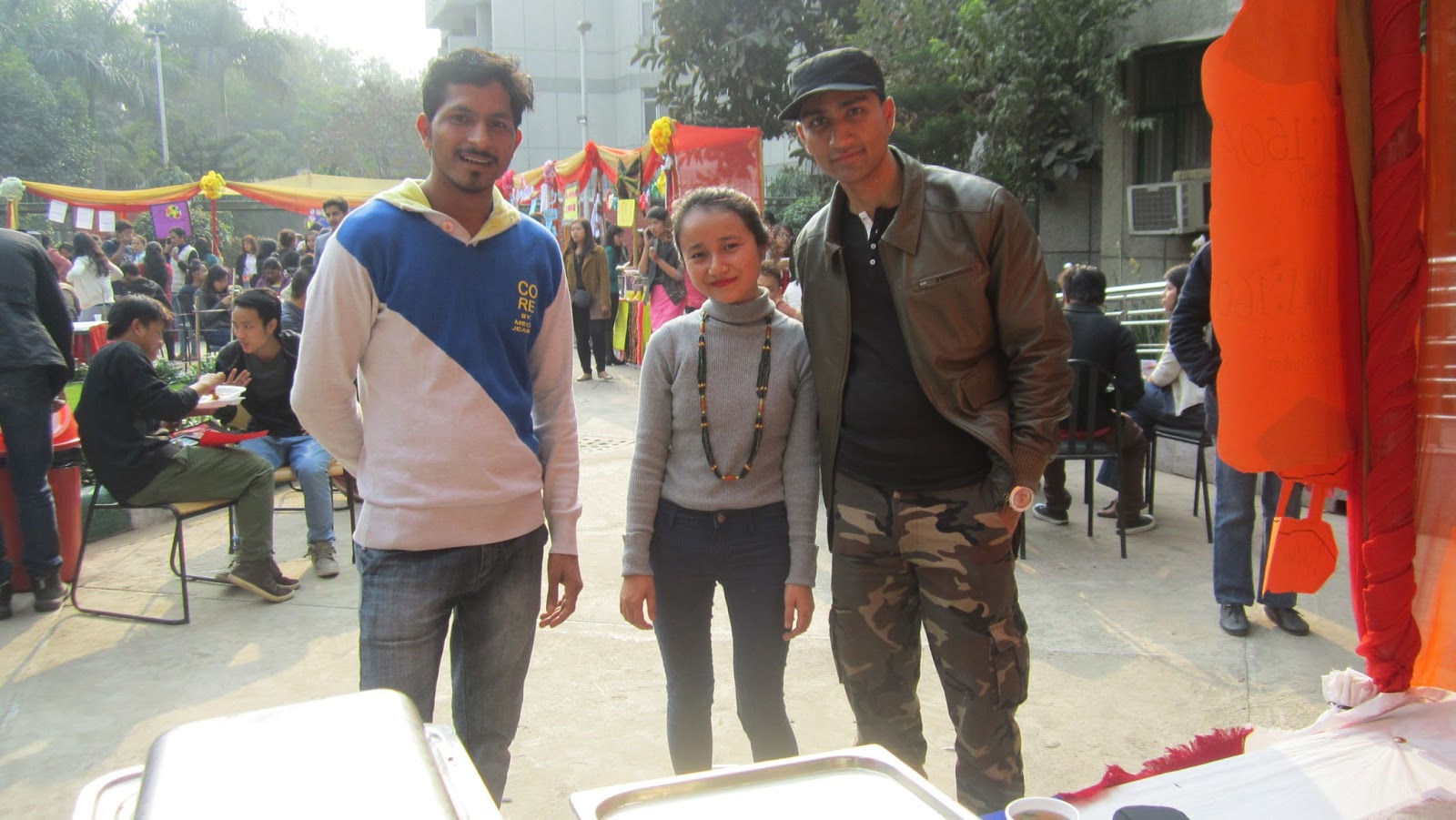
North-Eastern Food Festival

As I approach the end of this post, I recall a very strange occurrence. About 2 years back, as I boarded a bus back to my home after getting over with my routine evening-run, a stranger broke the ice with me. And oddly enough, he did it straightaway by making a prophesy to me, as if he had known me since a very long time. He said that I will get settled in a career after I turn 27 years of age.

For now, I am 26 and I am waiting to witness the weight in the seemingly soothsayer’s statement. I can only say that I strive to keep my actions in consonance with the motto “अग्रसरत सर्वदा” (Forward Ever).

Being a "Yes Man" versus Being [Hu]man[e]

  Being a "Yes Man" versus Being [Hu]man[e] 27 June marks the Death Anniversary of Field Marshal (FM) Sam Hormusji Framji Jamshed...