21 April 2020

Leadership

“Success spells Hard Work”.
“Dignity Decorum Devotion”.
“Service Before Self”.
“Work is Worship”.
“Dedication, Steadfastness and Truth”.

Institutions often claim to have committed themselves to a cause, which they usually project by way of an adopted motto. Though surely there would be many, I haven’t personally come across an institution which lays claim to “producing” leaders with an output-to-input ratio of 1:1.

Leaders, as the word would suggest, are those individuals from amongst a group of people who have the capability of guiding that group towards achieving a particular cause by setting imitable personal examples intermittently. In all walks of life, and across professional/non-professional fields, leadership can be found in varied dimensions. Truly speaking, no blueprint or prototype could be defined in a textbook manner, adopting which could turn an individual into a leader. Nor can conferment of institutional authority over an individual automatically turn him/her into a leader. Some leadership qualities may be found in an individual in situ (“nature” —so to speak) and yet others can be developed in an individual over the passage of time (through “nurture”).

As we move through the possible reasons for requirement of leaders to the various leadership qualities (which I shall categorize into essentials and desirables), we shall try to examine what it takes to become a leader. In the process, I hope that readers would associate examples from their own professional/non-professional lives to analyze whether many amongst the individuals whom they observe playing leadership roles are worthy of being termed ‘leaders’, or that most of them are merely paying lip service in their roleplay.

Why a Leader?

While not going into the historical instances of origins of leadership, one point-of-view about the requirement of a leader shall be hereby explained. It would have been splendid, had all the individuals who wish to achieve a particular cause, or who are placed at a particular institutional pedestal, possessed a quality of thinking and acting unanimously all the time. Practically, there is always a requirement of a moderating/governing body which carries out the task of rational assessment of each and every step that is proposed to be taken to achieve a particular goal. Such a body, at the helm of its affairs, needs to have a leader who directs logical discourses and finally sanctions a particular course of action on behalf of all the individuals who wish to achieve a particular cause. Additionally, an individual who has been chosen to be the leader, is expected to possess and put to use certain qualities (essentials and desirables) which most other people belonging to that group might be lacking. In institutions which have designated leadership roles, the person holding a leadership role is expected to have (or to have developed) such qualities through education and/or experience. In the following paragraphs, the term “leader” has been contextually used to represent someone who has either been chosen as a leader of a group devoted to a particular cause or someone in whom an institutional authority to play a leadership role has been vested. An underlying assumption has been taken that the followers/subordinates do not have their personal ambitions of usurping the leadership role.

Let us first have a look at the Essential Leadership Qualities which are required in an individual for a leadership position:
1.      Truthfulness: There is a Latin maxim which states Vi Veri Universum Vivus Vici—by the power of truth I, while living, have conquered the universe. The most important aspect of functioning of a group/institution to be understood by a leader is the fiduciary aspect. Truth forms the very foundation of group/institutional relationships. A leader who, through both word and deed, projects the true aspects of any issue in front of his followers/subordinates is bound to have an environment devoid of suspicion. Furthermore, the leader should understand that on a continuous basis, the leader has to build mutual trust among all the individuals present in the group/institution.
Often, individuals might tend to view truth through their own perspective and they may contend that truthfulness can be issue-based. The habit of viewing truths from a particular perspective may be developed through nurture. However, an individual’s instinct about effective communication of a particular truth is something which cannot be taught through nurture, but rather has to be natural.
2.    Determination: A leader’s commitment to achievement of a particular cause is directly proportional to the intrinsic quality of determination which the leader should possess in situ.
3.      Perseverance: There is a very famous story about how King Robert the Bruce was inspired by a spider as to how one should keep on pursuing a goal despite the oddities. Perseverance is the practical manifestation of determination. No benchmark could objectively be defined for this quality; nevertheless, this in situ quality is something whose glimpses are visible in a leader’s day-to-day actions.
4.      Courage: There are many forms in which courage, which could be called an umbrella term, can be exhibited. Courage is required to form an independent opinion and to thereafter stand by it. Courage is also required to persevere ‘when the chips are down’.
One of the finest examples of courage is the ability to render support to the followers/subordinates against the adversaries or the institutionally more powerful. In this regard, Field Marshall SHFJ Manekshaw had famously stated:
“A ‘Yes Man’ is a dangerous man. He is a menace. He will go very far. He can become a minister, a secretary or a Field Marshall but he can never become a leader nor, ever be respected. He will be used by his superiors, disliked by his colleagues and despised by his subordinates. So, discard the ‘Yes Man’”.
5.       Empathy: Simply put, any action before execution should always be put to test by the leader by proverbially putting himself/herself in the followers’/subordinates’ shoes. Empathy is something which cannot be simply taught to someone. It is essentially the part of someone’s nature. The power that a responsible position confers upon a leader should not be used to reign in corruption. A simple self-assessment test for a leader is that the moment when he/she has to assert his/her authority in execution of an action by explicitly verbally stating it is also precisely the very moment when he/she has failed miserably in being a true leader.
6.     Adaptability: Adaptability to the environment is a testimony of the intelligence and emotional quotient of the leader. Change is the law of nature and thus inflexible individuals, when they are assigned leadership roles, are bound to bring a downfall to the group/institution.
7.    Self-Control over Prejudice: To err is human. Human beings are vulnerable to forming prejudicial views based on non-balanced opinions/perspectives. However, the job of a leader is to make sure that self-control wins over prejudiced views while deciding about the fate of his followers/subordinates.

Having gone through the Essentials, the Desirables for a leadership position are as follows:
1.         Logical Thinking: Any decisions which are taken based on logic are bound to stand a greater chance of success. One of the aspects of logical thinking are to take into consideration alternative points of view, and to not merely dismiss/snub counter-views as regressive ones.
Definitiveness should be exercised only after a due logical deliberation over the varied view-points concerning an issue, not before it. Prejudicial rejection of view-points could be a result of ego, which is not beneficial for the group dynamics.
2.        Rhetoric: Rhetoric, one of the three ancient Greek arts of lower division (Grammar and Logic being the other two), is the art of persuasion through spoken or written word. A leader’s soft-skill of non-coercive persuasion is a very effective tool in getting a task executed; it also helps in preservation of respect in the minds of the followers/subordinates towards the leader.
3.  Positivity: Positivity in the leader percolates in a top-down way through the entire group/institution. It is an asset for the mental well-being of components of the group/institution.
4.   Morality: Morality and ethics cannot be simply described in a nutshell. It is, however, instinctive thinking that sets aside a leader from the herd. Walking the walk after having talked the talk is one of the confidence-building measures that emanate from morality. Truthfulness, which has been enlisted as a separate essential quality, is another aspect of morality.

A person aspiring to be a leader should always know that his/her word and deed are almost always in scrutiny under the watchful eyes of his/her followers/subordinates. The simplest and yet most effective maxim that leaders should follow is ‘Look before you leap’. Sometimes, silence is indeed, proverbially speaking, ‘golden’. Leadership, as has been said, can never be based on a rigid prototype; it is rather the by-product of the exercise of a judicious mix of the essential and desirable qualities in an individual.

15 March 2016

FLASHBACK

आशियाने की तलाश में सड़क की राह पकड़ी थी,
आज इतनी दूर निकल आया हूँ कि सड़क ही आशियाने-सी लगती है।

Keep on Walking
On 18th of July 2015, I had embarked on a new journey. After having toiled in the preparation for civil services examination, which did not fetch me the desired results, I joined Campus Law Centre under the Faculty of Law, University of Delhi, to pursue a degree in law—Legum Baccalaureus (LL.B.).

Presently, as I turn back and reminisce, time seems to have, as always, played a bittersweet symphony for me. Getting to meet and know about a lot of new people was one of the perks associated with coming back to the ‘campus life’. I may not say with any sense of conviction how many of them would be desirous of being in touch with me in future, or whether they would cherish the moments, even if fleeting ones, that I had spent with them. Looking from my lenses (I may be at risk of being accused of having a myopic vision), the ‘juice was worth the squeeze’, the moments gained were worth the time invested.

It is very cumbersome, simple though it may seem to be, to ‘define’ what is bliss. I do not claim any extraordinary erudition for myself in this regard. I do, however, recollect a few instances of events, the memories of which I surely will associate with the word ‘bliss’:

  • It isn’t everyday that one may get to spend quality time with an old friend. Impromptu conversion of a previously planned 100-kilometre road trip into a 200-kilometre one is a very small input for the aforementioned output.
Chakrata Road Trip
  • Upon evaluation of the returns, a 3-day Delhi–Jammu–Delhi trip doesn’t at all seem to be hectic or tiresome. After all, it is not everyday that you have a C2H5OH-induced debate over philosophy, followed by a late night drive to a remote lake area, on the way to which you muse over fictitious ghost stories.
Jammu Trip
  • The numerous birthday celebration events (‘events’ = cutting the cake + posing for photographs) in the college used to serve as beautiful reminders of my childhood birthday-celebration parties, in which my family members used to painstakingly prepare and serve delicacies to my friends and other guests.
Birthday Celebration
  • A visit to Delhi Book Fair 2015, the morning exercise sessions on the Lake Park near Brigadier Hoshiyar Singh Marg and the occasional ‘kaju shake’ sessions with friends, visits to Jawaharlal Nehru University campus, a visit to a friend’s Passing-out-Parade ceremony and pipping him on the shoulders, numerous chit-chats and text message exchanges on WhatsApp and Telegram—are all grand memories.
Delhi Book Fair 2015

Jawaharlal Nehru University
WhatsApp Chat Excerpt
WhatsApp Chat ExcerptWhatsApp Chat Excerpt


  • A solitary 90-kilometre/5-hour bicycle road trip and a Dehradun–Mussoorie–Landour 8-kilometre trek with a friend act as minute reminders that the strength in my body hasn’t veined with the passage of a few years. The memories of my mother’s reaction over the phone upon receiving the news of my bicycle trip—that “you’ve gone half-mad”—and of the alarmingly chilli-chutney served alongwith the plate of momos at a joint in Landour are invigorating instances for the mind.

Dehradun–Paonta Sahib–Dehradun Bicycle Trip

Mussoorie–Landour–Lal Tibba Trek
  • Words of encouragement from a childhood friend—“if that mole-rat” (please mark the use of a metaphor for a chap) “could make it to the top of Chandrashila, why can’t we?”—are not heard often, but are to be cherished.
Way to Chandrashila
  • An unforgettable memory is of my mother’s comment when I reached home after a long and arduous Srinagar Garhwal–Chandrabadni–Srinagar Garhwal hill drive followed by a ‘session’ with a childhood friend on New Year’s eve—that I behaved “like a roadside driver who needs to consume to pacify and relax the senses after a long drive”!
  • In certain places of the country, certain miscreants are occupying media space and trying to chart out a political future for themselves by resorting to shenanigans and gimmickry through vague and illogical statements based on dumbfounded concerns. They feel that they ‘need azaadi within the country, and not from it’, even as they simultaneously lead other unsuspecting, but emotionally-belligerent, pawn-like adherents through highly romanticized notions of petition-protest-purge. And all this is done from the comfortable couch of a university campus. But there are other places in the same country where time seems to have come to a still. People are not bothered about sloganeering for unfounded aims; rather, there is a need to ensure survival and fulfilment of basic necessities. The Gonds of Chhattisgarh and the residents of Munsyari (Uttarakhand) seem to be living in their own world of time-dilation. A stay for about 10 days at a Naxalite-infested area in Bijapur district (Chhattisgarh) was an experience of its own kind. Making a feline friend in that location, displaying herpes-induced “Raymond Shirts-styled” real-world advertisements, visiting certain girls’ and boys’ residential schools located in the nearby areas, driving a truck, sharing some lighter moments and playing practical jokes—were some of the many take-aways from that visit. I think [my friend will understand this very well as he reads it] that we surely know ‘how to make enemies and offend people’!
Chhattisgarh Trip

Similarly, a visit to a small pond (Thamrikund) and a late evening bath in a hot-water sulphur spring followed by the unfortunate event of a stolen mobile phone was a cake, the icing on which was put by dirt-biking over dust-and-pebble-strewn sloping road from Munsyari to Madkote and back to Munsyari. In Munsyari, time comes to a halt as people find solace in playing carrom and cards, as also in placing small bets over these games, which do attract a crowd of quite-a-size. All this seems to happen under the supervision of the imperial Panchachuli peaks.
Munsyari Trip
  • The memory of pedal-boating on a lake and of teasing a friend to consume ‘duck-roast’ from among the ducks which we were feeding [corn] and fattening is certainly a harbinger of solace. And…how can I fail to mention here?—the almost-Monsoon-Wedding (or rather, a ‘Western Disturbance Wedding’, to be technically-and-meteorologically correct) of a friend.
Naini Lake (Model Town, Delhi)

'Western Disturbance Wedding'

बयाँ करने को तो बहुत-कुछ है, मगर ये लफ़्ज़ कुछ खफ़ा-से हैं।
हसरत महज़ इतनी है कि वक़्त की रफ़्तार कलम पर भारी न पड़ने पाए!


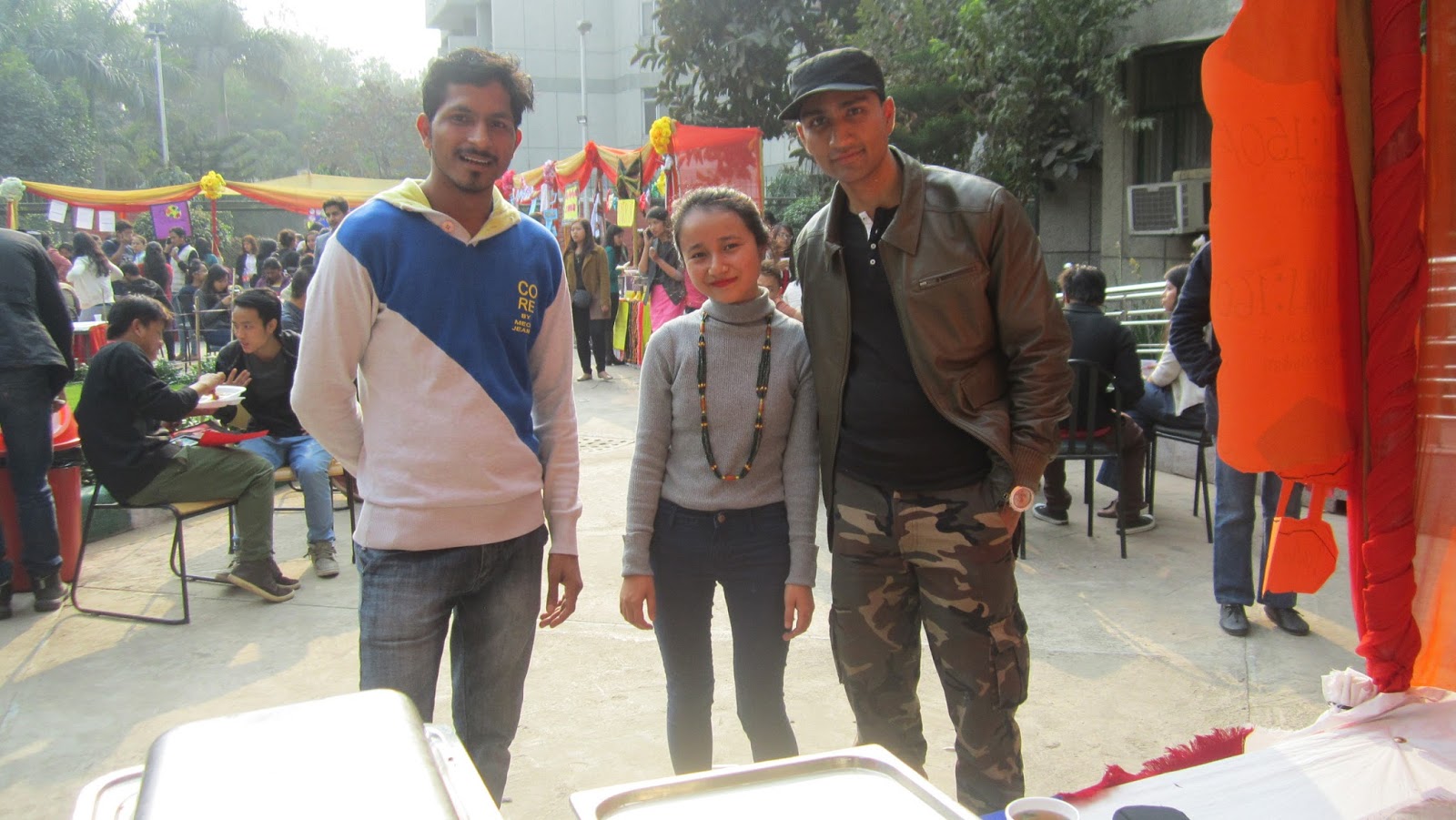
North-Eastern Food Festival

As I approach the end of this post, I recall a very strange occurrence. About 2 years back, as I boarded a bus back to my home after getting over with my routine evening-run, a stranger broke the ice with me. And oddly enough, he did it straightaway by making a prophesy to me, as if he had known me since a very long time. He said that I will get settled in a career after I turn 27 years of age.

For now, I am 26 and I am waiting to witness the weight in the seemingly soothsayer’s statement. I can only say that I strive to keep my actions in consonance with the motto “अग्रसरत सर्वदा” (Forward Ever).

12 June 2015

Movies: Wonderland versus Reality

It seems that the days when Bollywood movies used to be harbingers of fantasy are coming to an end. The burgeoning middle class, which has been made economically stronger by the fruits of the Liberalization-Globalization-Privatization (LPG) era, seems to be developing an appetite for movies that project reality. The "silver screen" isn't expected to portray demi-gods and demi-goddesses romantically dancing around trees and in grasslands anymore. If there is an element of entertainment in the movies, it has to be invariably interlaced with information—to give rise to "infotainment".

Movies and Reality

The current climate in the Indian movies seems to be veering towards a projection of the hard facts of the society. Take the case of the movie 'Oh My God'. The movie brilliantly conveyed to the audience how certain sections of the society indulge in commodification of religion, spiritual beliefs, talismans and in propagation of idolatry by deifying material objects to serve their own vested interests. It is no wonder that the movie had drawn sharp criticism from the intolerant sections of our country—sections that consider it their birth-right to get offended at every possible work of art, even if the bona fide intent of the work is to bring positive social reform.

Another positive role played by the movies has been to portray systemic failures, i.e., failure, for various reasons, in the working of the institutions of the State. The movies Khakee, Yahaan, Shaurya are some of the stalwarts in this area. Then, the movie Swades had tried to bring out the development deficit in the rural areas of India and had tried to link it with the phenomenon of "brain drain". It is a pity that though such movies receive huge critical acclaim, they do not perform so well at the box-office! Movies have an educational role too. They try to enliven in the memories of the people important historical events, e.g., Richard Attenborough's English movie Gandhi. Movies try to spread awareness about art and culture; they also help in the promotion of tourism.

The ushering of a "new age" in the movies has seen various filmmakers (actors and producers), prominent among them being Anurag Kashyap, Prakash Jha, Shoojit Sircar, Farhan Akhtar, trying to rope in new themes for their creations. Farhan Akhtar displayed this in the movie Zindagi Na Milegi Dobara, in which he tried to portray the need of Work-Life Balance and the negatives of an excessive desire for materialistic success. In the movie Chakravyuh, Prakash Jha tried to bring out a fictionalized story set in the backdrop of Left-Wing Extremism, which has (in the words of former Prime Minister Manmohan Singh) emerged as the biggest internal security challenge to India. Shoojit Sircar tried to bring out the fictionalized versions of terrorism in Jammu & Kashmir in his movie Yahaan and the Indian intelligence operations in the civil war between the Sri Lankan government and the Liberation Tigers of Tamil Eelam (LTTE) in his movie Madras Cafe. He also subtly-yet-boldly projected the theme of sperm donation and related societal mindsets in his movie Vicky Donor. Then, filmmakers have also tried to bring widespread popularity to sportspersons through their movies—Milkha Singh ("Flying Sikh") in Bhaag Milkha Bhaag and MC Mary Kom in the movie Mary Kom.

Movies on a different pedestal?

Why are movies treated at a different pedestal when it comes to setting the standards for their content? The main reason seems to be the widespread grasp of movies on the minds of the people as compared to other forms of mass media. This is, perhaps, because of the combined effect of the literary content and dialogue delivery interlaced with background score and powerful visuals. Also, watching a movie doesn't require reading skills (necessary for print media), access to television sets (necessary for electronic media) or access to smartphones/computers (necessary for social media). Thus, it is no wonder that movies seem to grab the headlines much before they are released—when they apply for a certification from the Central Board of Film Certification (CBFC). What is a cause of concern, though, is the fine line between censorship and editorship. Many-a-time (e.g., in the recent case of CBFC Chairman Pahlaj Nihalani's issuance of a list of "cuss words" that were to be prohibited to be used in movies and the subsequent withdrawal of the list after it was vociferously objected to by various filmmakers as an attempt to bring in totalitarianism by stifling creative freedom), this fine line has been disregarded. Another scenario is when certain state governments issue diktats to ban the screening of a particular movie on the pretext that it may otherwise inflame public sentiment and may thus create law and order problems. A case in point is that of the English movie Dam 999 whose screening was banned by Tamil Nadu government. The movie was perceived to be loosely based on the issue of the Mullaperiyar Dam, a contentious issue between Tamil Nadu and Kerala.

The 'star' culture

A noteworthy phenomenon of the Indian movies has been the creation of "celebrity-culture" or a "star-culture". The audience, especially the people belonging to the lower social-economic strata and the youth, elevate the actors to the level of demi-gods and demi-goddesses. This is further compounded by the other forms of mass media, whose journalists and the paparazzi clamour and fight hard to capture every small event of the actors' lives. Important airtime of the electronic media may be devoted to the changed hairstyles of the "celebrities" even at the cost of social issues such as poverty and hunger, because such "trivial issues" do not seem to generate enough Television Rating Points (TRPs) for the news channels. Sometimes, this hunger for celebrity news assumes the proportion of encroachment upon the private lives of these "stars". Some of the best examples in this category are those of the late M.G. Ramachandran ("MGR"), the late N.T. Rama Rao ("NTR") and Rajinikanth (born Shivaji Rao Gaekwad).

Movie celebrities are paid to perform or are present as chief guests at various functions organized by corporate entities and state governments, and even at private functions of politicians and wealthy individuals of the corporate world. They are also employed by various national and multinational companies as 'brand endorsers' (a phenomenon that cannot be overlooked due to the necessity of advertising and 'marketing' in the market economy). An observation, that I recently made in this regard, is of movie actors endorsing 'pan masala' products. Perhaps the companies, which hitherto used to make chewing tobacco and snuff, have been so remorseful after being chided by various Supreme Court and High Court judgments for gifting leukoplakia (precancerous white-coloured lesions in the mouth) and oral, esophageal, pancreatic cancers to the people of India that they have resorted to the employment of movie "stars" as brand-endorsers of pan masala, etc., to bring home the point to Indians that they need to freshen-up their mouths by savouring new attractively-packaged aromatic vitriolic products. What is funny is that I remember one of these very actors uttering in a dialogue in some movie that film "stars" who endorse some products in television commercials do not even sniff those products in real life!

"With Great Power comes Great Responsibility"

Given the large level of trust that is placed on the movie actors, who are treated as idols, there should be a sense of responsibility among the film actors towards the society. I quote a dialogue from the movie 'Lakshya' (even though taken out of context)—"...ye vishwaas bahut badi izzat hai aur bahut badi zimmedaari bhi"—this belief is a large honour as well as a large responsibility. Some of the positive work done by movie actors are the social initiative 'Men Against Rape and Discrimination' (MARD) by Farhan Akhtar and the positive work done by Celina Jaitley for the rights of the Lesbian-Gay-Bisexual-Transgender (LGBT) community, to mention a few.

But then, there are bad apples too. Salman Khan's positive initiatives through his NGO 'Being Human' may be grounds for, at the maximum, getting a remission of his prison sentence for crushing pavement dwellers under the wheels of his Sports Utility Vehicle. But his positive work carried out later does not absolve him of all the guilt. And then there was another "celebrity" singer Abhijeet Bhattacharya who compared pavement dwellers with dogs in his tweet; luckily for him, he apologized for his irresponsible comments. Sadly, wealthy actors rope in rich lawyers to bail them out of jail even as a large number of undertrials languish in the Indian prisons, sometimes for time periods crossing even the maximum sentence proscribed under law for the crime for which they were accused.

Another issue to be considered is the one of brand endorsements by celebrities, especially after the current nationwide ban on Nestle Maggi by the Food Safety and Standards Authority of India (FSSAI). Movie actors do have every right to endorse products as this fundamental right is covered under the Article 19 of the Constitution of India—freedom of speech and expression (for commercial purposes) and well as freedom of occupation (because the endorsement provides them with earnings). While it may be argued that the brand endorsers of the product couldn't have possibly known about the nutritional value of the product given that it is a thing of technical nature, that the product had already been cleared as safe by the food regulators, and that the actors cannot (in any manner) be held accountable for mens rea or for having mala fide intentions, there certainly has to be some degree of accountability. This is because the endorsers have a hegemonic stronghold on the minds of the vulnerable sections of the consumers. If movie actors are qualified to be awarded with Padma awards for excellence in their fields as well as for benefiting the society by their acts, they should be accountable to the society for an endorsed product that has been found unsuitable, more so if it is a food product. The least they could do is to issue public statements to forbid people from using any product if it is found unfit for use and to express that they had endorsed the product when they had no knowledge of any harm caused by it.

Then, there should be a certain dignified conduct by actors. There was widespread condemnation of the performance of Madhuri Dixit, Salman Khan, etc., on the concluding day of the Saifai Mahotsav in Uttar Pradesh (U.P.) even as many victims of the Muzaffarnagar Riots were suffering in makeshift camps and weren't even fully rehabilitated. While the "celebrities" might have promoted tourism and culture in the eyes of the U.P. state government, the function was widely criticized by various quarters among the civil society and the political parties for the huge fanfare amidst penury of the communal riot victims.


To conclude, it can be said that though the paparazzi shouldn't encroach upon the lives of the movie actors, the movie actors too must realize their responsibility towards the same society that has aggrandized them to the level of "stars" of the "silver screen".

08 May 2015

Nostalgia

Sometimes, a seemingly unfortunate occurrence may later on lead to an experience that ends on an entirely different positive note. Losing my Driving Licence, which I had kept in a [now stolen] wallet, gave me a reason compelling enough to re-visit the place where I had spent the foundational years of my life (because my licence was issued by the Regional Transport Office lying in the district under which the aforementioned place falls).

Srinagar Garhwal (henceforth referred to as Srinagar) used to be (when I was a child) a small town located in the Garhwal Commissionary of the hill state Uttarakhand (carved out of Uttar Pradesh state on 9 November 2000) in India. Historically, it used to be the Capital of the Garhwal Kingdom till 1804 AD. This was after the king Ajay Pal shifted his capital from Chamoli (the erstwhile Chandpurgarhi) to this place. At present, this place is the largest city (though its expanse is nowhere when compared to that of the cities in the plains of India) in the Garhwal hills. Srinagar is accessible from Dehradun, the capital of Uttarakhand, by road; the distance is about 150 km. The city has a Municipality and administratively, it is a tehsil under the Pauri Garhwal district. The city is home to Hemwati Nandan Bahuguna (HNB) Garhwal University, Government Medical College (Srikot), [presently] National Institute of Technology (Sumari) and the Sashastra Seema Bal (SSB) Officers' Training Academy. Situated on the left bank of the river Alaknanda (which is the largest tributary—in terms of water content—of the river Ganga), Srinagar is situated at an average elevation of 560 m above mean sea level. Contrary to the popular perception, the situation of Srinagar as a hill city doesn't reward it with an affable climate. It sees extremes of temperatures—hot summers and cold winters.

As I neared the police check-post at Srinagar Garhwal on 5 May 2015 (after a gap of almost 4 years) I realized that everything has changed in Srinagar, yet nothing has changed. The city had to bear the brunt of the 2013 Uttarakhand deluge. The river Alaknanda in all its fury submerged the buildings near the banks under enormous amount of debris. Yet today, except for some visible signs of the destruction in the areas near the banks, most of the city seems to have stood resilient in the face of adversity (even though I have been one among the 'locals' of Srinagar for a long time, this account can be considered to be of a 'local tourist' because I had stayed there for just two nights during my sojourn). However, I certify that despite having stayed there for a very brief period, I enjoyed undisturbed-untroubled sleep during the nights. Despite all the hardships that the people of the hills have to face, most of the the hill folks are innately unassuming (although, of late, materialist influences have started to make their foray in this city—all thanks to the revenue generated by the tourism industry during the 'Char Dham Yatra' and the 'Hemkund Sahib Yatra' as also the influx of the mining mafia in the hills). I felt inner solace when I met my old neighbours as well as an old classmate, almost all of who couldn't recognize me in the first instance and cited the reason that I have changed a lot during the passage of the intervening years.

I would like to take a short detour. Even as many of my fellow Indians were busy expressing solidarity with Salman Khan when he was convicted by a sessions court and awarded a 5-year rigorous imprisonment for drunk-driving and trampling pavement-dwellers, I felt much better off by switching-off the television (which I anyway seldom watch) and then enjoying the beauty of the Garhwal hills. Perhaps Mr Khan realized what it is being human [as the accusations against him go] after having hunted chinkaras and black-bucks in 1998 and trampling humans in 2002. As for Mr Abhijeet Bhattacharya, even though you have apologized in public (and it's good that you have done so), let me re-iterate that your tweets were simply unacceptable. To hell with what you did when you had no work, pavement-dwellers are not dogs; you may have intentioned to support a fellow Bollywood personality who runs an NGO by the name "Being Human" but 'being human' includes conferring a compassionate treatment even on animals (and not trampling them under the wheels of your vehicle).

I have uploaded some photographs which I had clicked during my sojourn at Srinagar Garhwal. Some people opine that a picture is worth a thousand words. I hope that the following pictures are able to present glimpses of what I would like to refer to as my 'personal paradise'. I say—"Kuchh din to guzaaro mere Srinagar Garhwal mein" (please spend some days in my Srinagar Garhwal).

Aithana ('ऐठाणा') Village
'Aithana' ('ऐठाणा') village


Aithana ('ऐठाणा') Village
'Aithana' ('ऐठाणा') village


Aithana ('ऐठाणा') Village
'Aithana' ('ऐठाणा') village


Trek Route from 'Aithana' ('ऐठाणा') village to Ashthavakra ('अष्ठावक्र') temple
Trek Route from 'Aithana' ('ऐठाणा') village to Ashthavakra ('अष्ठावक्र') temple; trekking along this path in the morning brought back memories of school days when I used to go for this trek alongwith some of my classmates


Pine trees or 'Pinus roxburghii' ('चीड़')
Pine trees or Pinus roxburghii ('चीड़'); as per one story, these were introduced to Uttarakhand hills by the British who wanted to exploit them for their commercial value; due to the high resin content in their wood, they are used as firewood and their 'needles' almost form a near-ubiquitous carpet on the hills because of which the hills become highly prone to forest fires (दावानल)

'Needles' of Pine trees
Natural Carpet formed by the 'needles' of Pine trees
Female Cone of Pine tree
Nuisance of Human Intervention
Alas! Excessive human intervention is turning out to be bad for the hills. Is this what 'Being Human' is?
A part of Srinagar Garhwal
A part of Srinagar Garhwal (photograph captured from an elevated spot on a hill)
Blue Jacaranda or 'Jacaranda mimosifolia'
Blue Jacaranda or Jacaranda mimosifolia (the violet-flowered tree)

Being a "Yes Man" versus Being [Hu]man[e]

  Being a "Yes Man" versus Being [Hu]man[e] 27 June marks the Death Anniversary of Field Marshal (FM) Sam Hormusji Framji Jamshed...